
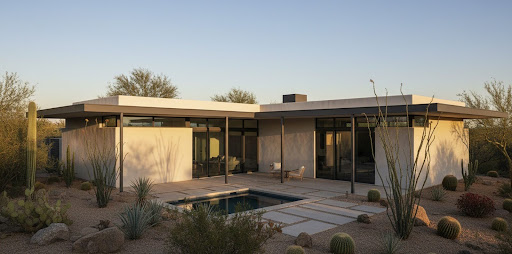
Phoenix doesn’t ease you into summer. By late May, daily highs regularly clear 100°F, and by July, your home’s floor plan is doing just as much work as your HVAC system. The way a house is laid out, where the windows sit, how the roof handles direct sun, and how much usable shade exists outside all affect how comfortable you are indoors and how much you pay to stay that way.
That’s why choosing house plans for a desert climate requires a different kind of checklist than building in, say, the Pacific Northwest or the Midwest. In Phoenix, the plan itself is part of your cooling strategy. Below, we’ve broken down the best house plan designs for Phoenix based on the specific layout features and architectural details that help a home perform in extreme heat. If you’re building in the Valley, these are the styles and plan elements worth putting at the top of your list.
1. Single-Story Plans With a Compact Footprint
Two-story homes have their place, but single-story plans offer a real advantage in Phoenix. Heat rises, and a second-floor sitting directly under the roof absorbs the worst of it. In a single-story layout, you can insulate and ventilate the attic space above the entire living area, creating a buffer between your ceilings and the blazing roof.
A compact footprint also means less exterior wall space exposed to the sun. The more spread out a home is, the more surface area absorbs radiant heat throughout the day. Look for single-story hot-climate house plans that cluster bedrooms and living spaces efficiently rather than stretching them into long wings. That tighter envelope is easier and cheaper to cool.
What to look for in a plan: Centralized HVAC placement (shorter duct runs lose less cooled air), high ceilings for heat stratification, and attic space with room for heavy insulation.
2. Courtyard-Style Layouts
Courtyard house plans are practically engineered for desert living. The enclosed or semi-enclosed outdoor space sits protected from wind-driven dust and direct afternoon sun, creating a shaded microclimate in the center of the home. Historically, builders across the American Southwest, the Mediterranean, and the Middle East used this layout for exactly this reason.
In a Phoenix courtyard plan, the home’s rooms wrap around a central patio, so the interior walls facing the courtyard get shade from the structure itself for most of the day. This reduces the heat load on those walls significantly compared to fully exposed exterior surfaces. Add a water feature or some potted desert plants, and you’ve built an outdoor room that’s genuinely usable even in July.
Many of our southwestern-style house plans incorporate courtyard elements, and they’re some of the most popular picks among Arizona buyers.
What to look for in a plan: A true courtyard (fully or partially enclosed by the home’s wings) and sliding or folding glass doors that open living spaces to the courtyard.
3. Plans With Deep Roof Overhangs and Covered Porches
In Phoenix, shade isn’t a luxury. It’s infrastructure. A house plan with deep roof overhangs (two feet or more) keeps direct sunlight off your exterior walls and windows during the hottest hours of the day. That single detail can meaningfully reduce indoor temperatures and lighten the load on your cooling system.
Covered rear porches and patios extend that same principle to your outdoor living space. A standard uncovered patio in Phoenix is unusable for roughly four months of the year during daylight hours. A covered patio with ceiling fans and misting capability becomes a functional room that you can use year-round.
Southwest house plans and Spanish-style house plans tend to feature generous overhangs as a core design element, not an afterthought. If you’re comparing plans side by side, pay close attention to how much covered outdoor square footage each plan includes.
What to look for in a plan: Overhangs of at least 24 inches on south- and west-facing walls, covered patios with enough depth to shade the adjacent windows, and outdoor ceiling fan pre-wiring.
4. Energy-Efficient Plans With Strategic Window Placement
Windows are one of the biggest heat-gain culprits in any home, and in Phoenix, a large west-facing window can turn a room into an oven by 3 p.m. Energy-efficient house plans for the desert prioritize where glass goes, not just how much of it there is.
The best house plan designs for Phoenix minimize glazing on the west elevation and concentrate larger windows on the north side, where they bring in soft, indirect light without the brutal heat gain. East-facing windows get morning sun, which is manageable. South-facing glass can work well with proper overhangs that block the high summer sun but allow lower-angle winter light to warm the home during cooler months.
This isn’t about eliminating natural light. It’s about controlling it. A plan with thoughtful window placement will feel brighter and more open than one that scatters oversized windows across every elevation without considering orientation.
What to look for in a plan: Smaller or fewer windows on the west elevation, clerestory windows for daylighting without direct heat gain, and notation of low-E or dual-pane glass specifications.
5. Plans With Attached but Buffered Garages
House plans for hot climates that position the garage on the west or southwest side of the home use the garage as a thermal buffer, absorbing afternoon sun before it reaches your living spaces. Plans that include an insulated shared wall or a utility/laundry room between the garage and the main living area add another layer of protection.
If you’re looking at a plan with a front-entry garage, check which rooms sit directly behind it. If it’s the primary bedroom or family room, you may want to request a modification or choose a different layout.
What to look for in a plan: A garage on the west side of the home, a buffer room (laundry, mudroom, pantry) between the garage and primary living areas, and insulated garage-to-house walls noted in the specifications.
6. Open Floor Plans With High Ceilings
Open floor plans serve a functional purpose in Phoenix. Large, connected living areas allow cooled air to circulate more freely throughout the home, reducing the hot spots that develop in homes with lots of closed-off rooms and narrow hallways.
Pair that open layout with high ceilings (10 feet or above), and you get meaningful heat stratification: the hottest air rises to the ceiling while the cooler air you’re breathing stays lower. Ceiling fans in these spaces push that stratified air around, which makes the room feel cooler without dropping the thermostat.
Many of the house plan designs for hot climates in our collection feature great rooms with 10- to 12-foot ceilings that connect seamlessly to the kitchen and dining areas. It’s a layout that feels spacious and performs well thermally.
What to look for in a plan: Great room ceilings at 10 feet or higher, an open kitchen-to-living connection, and ceiling fan pre-wire locations noted on the electrical plan.
7. Desert Contemporary and Southwestern Designs
If you want a home that looks like it belongs in the Sonoran Desert and performs like it was built for it, desert contemporary and Southwestern-style plans deserve a close look. These styles evolved specifically for arid climates, so their design DNA already accounts for extreme heat, intense sun, and minimal rainfall.
Southwestern plans lean on flat or low-slope rooflines, clean stucco exteriors, earth-toned color palettes, and strong indoor-outdoor connections through walls of glass that face shaded courtyards or covered patios. They also incorporate details such as exposed wood beams (vigas), arched doorways, tiled roofs, and textured stucco in warm terracotta tones.
Both styles favor thermal mass materials like concrete block, stucco, and stone, which absorb heat slowly during the day and release it after sundown when desert temperatures drop. That natural temperature buffering makes a noticeable difference in cooling costs.
What to look for in a plan: Stucco or masonry exterior walls, flat or low-pitch rooflines with parapet walls for shade, and outdoor living rooms integrated into the main floor plan.
Built for the Sun: Find Your Phoenix-Ready Plan
We carry thousands of house plans that you can filter by architectural style, square footage, stories, and specific features. Every plan in our collection includes detailed floor layouts and elevation drawings so you can evaluate window placement, covered outdoor space, and garage orientation before you buy. Start browsing today and find a plan that’s built to handle everything a Phoenix summer can throw at it.
Frequently Asked Questions
Can Monster House Plans help me estimate build costs in the Phoenix area by ZIP code?
We don’t provide ZIP-code-specific cost estimates, but any plan you purchase from us can be taken to a local Phoenix-area builder for a detailed bid. Experienced Valley builders can give you a cost-per-square-foot estimate based on the plan’s complexity, your finish selections, and current material pricing. We recommend getting bids from at least two builders, since pricing varies based on workload and subcontractor availability. Having the complete plan set in hand gives builders what they need to produce an accurate number.
Do Monster House Plans include Phoenix-specific engineering (soil, seismic, wind, etc.)?
Our plans are designed as construction-ready architectural documents, but they don’t include site-specific engineering for soil conditions, seismic requirements, or local wind loads. In the Phoenix metro area, your builder will typically coordinate a geotechnical soil report and a structural engineer’s review to ensure the foundation and framing meet local code. Maricopa County has specific requirements that vary by municipality, so a local structural engineer will stamp the plans to confirm compliance. This is a standard step in the building process and something your builder or general contractor will handle.
If I need to change window sizes or placement for harsh west-facing sun, can Monster House Plans modify the plan?
Absolutely. We offer plan modification services for exactly this kind of adjustment. Resizing or repositioning windows on the west elevation is one of the most common requests we get from Phoenix-area buyers, and it’s a straightforward change. You’ll work with a design professional who will mark up the revisions and produce an updated plan set. Modifying an existing plan is significantly faster and more cost-effective than starting from a blank page, and it ensures your home is optimized for your specific lot orientation and sun exposure.